

In this retelling of the classic myth, the main plot points remain the same but Eros is feminine-presenting, genderfluid (?) and intersex.
Spoilers below!
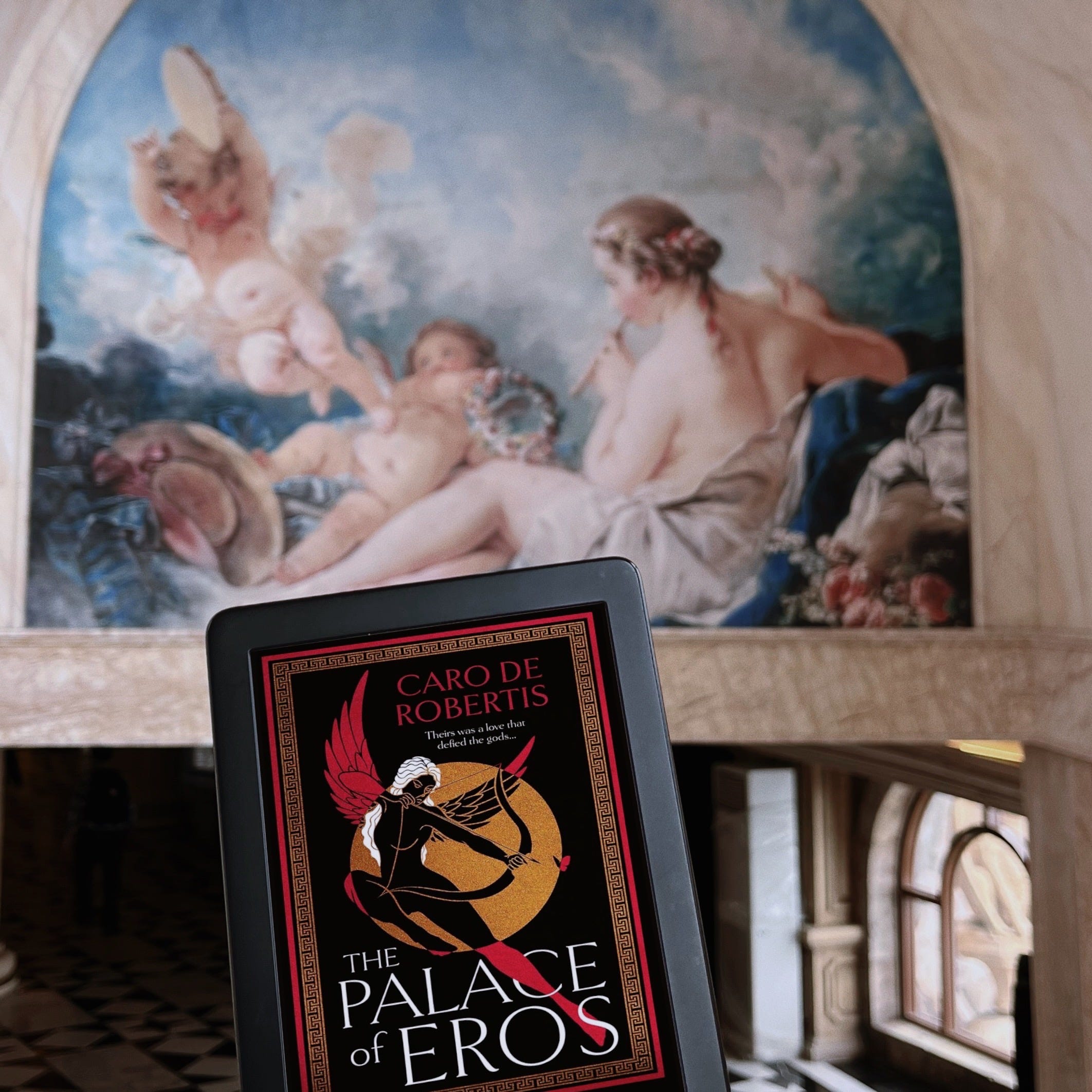
Psyche has had a hard life growing up. Her father wishes he had sons and likes to hit his wife and daughters and her sisters find her too strange and exclude her from their shared world. She is lonely. The only thing sustaining her is her mother’s love, but even that can’t save her from her eventual fate of being traded for money like cattle through marriage to some man her father chooses for her. She spends her days doing chores and weaving at the loom while dreaming of freedom. One day, her sisters are deemed of marriageable age and suitors are invited to their house. However, Psyche’s great beauty (that she is unaware of) catches their eye instead, driving a wedge between her sisters and her. Rumours spread across the land and soon, suitors flock to her home to stare at her and get a glimpse of this girl whose beauty supposedly rivals Aphrodite’s. Psyche hates it all and hates them all, feeling violated by their gaze. These men are scum who endanger the other girls in the area. Crops start to fail because Aphrodite is angry. The other villagers are looking for someone to blame, and it all falls on Psyche. Back home, things are tense and hostile. Her sisters are seething and resent her for stealing all the attention. Her father visits an oracle who tells him that Psyche will be married to a monster. She must be lashed to a rock on top of a mountain and sacrificed to her monstrous husband so that peace can be restored to the village.
Simultaneously, Eros is given an order by her mother, Aphrodite, to make Psyche fall in love with a thoroughly hideous brute. Aphrodite is pissed because of all the rumours saying that a mere mortal girl is more beautiful than her. She thinks that Psyche has stolen from her. (Not sure why all the women here think that male attention is a precious commodity.) Eros goes off to comply out of duty and loyalty, but falls in love instantly with Psyche instead. To trick her mother, she lies about having done what Aphrodite asked but actually, she sequesters Psyche away to a secret palace in a valley. The bedroom is completely dark. In the day, Psyche has free rein over the luxurious rooms. She sings, dances, paints, weaves, feasts, masturbates, bathes in flower petals, and does whatever she fancies at any moment. At night, she enters the bedroom and waits for her ‘husband,’ who she knows is not a man at all and is all the more grateful for it. Obviously, they have a lot of sex. Obviously, Psyche can’t help but wonder what her spouse looks like.
Psyche knows that Eros, whom she calls Pteron, is no ordinary woman. Although Eros has a regular woman’s body, the one difference is that she also has a fully-functioning penis that she can activate at will. We find out that Eros was simply born like this, with no clear boundaries around how her desire manifests. Being the goddess of desire, it made sense to her that she can take all its forms. However, Zeus cannot accept it and gets very, very angry. He mandates that Eros must take either a fully female or fully male form while having sex, nothing in between. Zeus also twists the narrative to promote the idea that Eros was jealous of his sexual prowess and sought to be like him (penis envy). Part of the deal was also that he got to watch Eros’ male form have sex with nymphs or mortal women for the first nine times. Clearly this is a disgusting voyeuristic request, so the traumatising invasion of privacy made Eros dread each sexual encounter and become turned off entirely. That is, until she met Psyche and love made her break all the rules and recover from Zeus’ violation.
Psyche asks Eros if her sisters can visit her so they can send word to their mother that she is doing well. Eros arranges it such that it can happen. Psyche, for some unfathomable reason, believes that they can be loving sisters and bond over the fact that they’re all married now, but it’s not happening. Her sisters are clearly resentful of her good fortune and gleefully seize at any hint of unhappiness or discontent. They keep trying to twist her new joy into discomfort because they can’t stand how good she has it through no effort of her own. Her sisters also encourage the doubt that was planted in Psyche’s mind. The doubt and desire for freedom grow when she finds out that she is pregnant. In her second trimester, Psyche thus decides to break the rules and shine a lamp on Eros after she has fallen asleep. She was so engrossed looking at her spouse that she accidentally drips hot oil onto Eros’ shoulder, waking her up. Eros flees and leaves Psyche trapped in a crumbling palace with no food, no running water, and no more magic to sustain her survival.
Eros gets locked in a room by her angry mother where she spirals and mopes. In the meantime, Psyche risks life and limb climbing her way out of the valley. She calls on Aphrodite and declares that she is pregnant, begging for clemency. Aphrodite says okay, but only if she passes the trials. For the first trial, she must sort a huge pile of seeds. Psyche calls upon Demeter for help, who sends her ants to finish the job in no time. Demeter also pops by Psyche’s prison to gently chide her. For the second trial, Psyche is tasked with collecting wool from some very scary sheep. She manages by drawing upon her knowledge of shepherding in her childhood home. For the third trial, Psyche needs to venture into the underworld, a place usually reserved for the dead, and ask Persephone for a box of her beauty. She succeeds by calling upon an ancient goddess from her mother’s non-Greek side of the family, Vanth, who gives her a ride all the way to Persephone’s throne. Even though she succeeds in getting a box of her beauty, she gets angry at how Aphrodite treated her and throws the box into the sea.
By this time, Aphrodite has forgiven Eros and went off to convince Zeus to bless their union. Eros appears before Psyche and they have a very long and honest talk. Eros asks Psyche to marry her anew, this time on Mount Olympus with all the gods and goddesses in witness. She is also offered immortality. Psyche thinks about it, sets down some terms for their union that they both agree to, then accepts Eros’ proposal. They live happily ever after.
End of synopsis.
I’m not sure why the initial ratings of this book on Goodreads are so low because I thought it would average between 4 and 5 stars. If I had to guess, it’s probably the style. It did strike me as I was reading that this was not the usual prose that came out of North American or UK writers. When I flipped to the back, I saw that the author’s from Uruguay, which explained things for me. The style is more dreamy and meandering, which I do think contributes to the reading experience, but which not everyone will be pleased by. The lengthy and elaborate moments of introspection also lead to a slower pace. Any physical action that happens, if it happens at all, is minimised and never dramatic when compared to the characters’ internal drama.
E.g., for the trials, which I guess is the most exciting part of the myth for most people, they were only a small percentage of the book and even then the events happened quite quickly and without fanfare or much tension. There is no blow-by-blow account of Psyche’s struggles before she emerges victorious and classically heroic. The final trial, usually high-stakes and climatic, ends bathetically and is hijacked by the romance plot. It can be a letdown if you were hoping for a dramatic showdown between MIL and DIL. The author’s choice to deprioritise the traditional climax of the story in favour of foregrounding the women’s internal turmoil is definitely an interesting one. I can see why it would affect popularity/ ratings, but I like that it doesn’t take the easy route and pander to a larger audience.
The portrayal of Aphrodite is also quite unique in this novel. I have not seen a retelling that casts her in such a positive light. Usually, she is portrayed as vain, jealous, cruel, and a total villainess. This book shows that she IS vain, jealous, and cruel, but not just that. Her character here is complex as she is also a loving and protective mother, deeply loyal to her daughter, and willing to put herself on the line to defend her only child. Aphrodite understands Eros and completely accepts her. On Mount Olympus, it is the two of them against the shifting tides of power. When Eros lies to Aphrodite about Psyche, her wrath stems not from jealousy of Psyche’s beauty but from hurt at her child’s betrayal.
The crux of the novel seems to be about how to achieve a truly equal relationship between two people—one that is built on fairness, sharing power, and understanding, but which must be grounded in self-respect and free will.
"I don't know. You are Eros, goddess of desire. It may be in your nature to roam . . . And yet I'd hate it if you did so and expected me to stay chained. Men do that, but I don't want to be that kind of wife. To be honest, I'm not sure I want to be a wife at all—I want to be with you, that's not what I mean. I'm talking about the word itself."
"The word 'wife'?"
"And 'husband.""
"Yes. I understand," said Eros. "They're too small, I can't fit all of myself into either of them."
"Neither can I."
. . .
"I want to do that, to be wife and not-wife, husband and not-husband, to take the word 'marriage' and stretch it in ways that would shock the old gossips and the bards."
This is more than just a gender-bent sapphic reimagining of the myth. By making Eros another woman, I think this novel cleverly tricks us into believing initially that their relationship was going to be smooth-sailing. I think this is possible only because we are already very aware of all the problems that can arise in heteronormative relationships—misogyny, physical and emotional abuse, entrapment, assault, forced impregnation, etc—and especially so in ancient times. We see many such examples throughout the novel. The author holds miserable women characters up as foils against which we evaluate Psyche’s situation, like Melia/ her mother/ her elder sisters. Any encounter with a man is one that is charged with violence, both latent and potent.
“If it’s two women, perhaps all these problems can be prevented and the relationship will be problem-free!” Well, not really. Anyone who has read Carmen Maria Machado can tell you that.
Even though Psyche and Eros are technically women/ feminine-coded, there is still a stark difference in how much power they respectively wield that makes it impossible for their bubble to remain un-burst. Once the honeymoon stage has passed and Psyche is no longer in survival/ gratitude mode, she comes to understand that a gilded cage is still a cage. Why can’t she go visit her mother? Why can’t she even set her eyes on her own spouse and look at the person she married? Why does her spouse get to just fly off and leave her for dead while she remains geographically stranded with no means of recourse or any way to get help? Once Psyche stopped playing by Eros’ rules and tries to even the playing field, she is left destitute, starving, homeless, covered in wounds, and pregnant to boot. How is that any different from being abandoned by a man? Eros realises this belatedly after getting scolded by her elders. The message seems to be that the real reason why so many heteronormative relationships fail or are fraught with challenges is not so much because of the Y chromosome (which is essentialist) but the established power imbalance between men and women that puts women at risk. One doesn’t need to be AMAB to be aligned with the masculine.
The section where Psyche and Eros reconcile and negotiate the terms of their relationship is pretty long. They don’t rush into it, or more specifically, Psyche does not allow herself to rush headlong into easy agreements. For the reader, this lack of a neat and snappy ending means that the denouement is delayed and could feel a little tedious, but I think there is real intention behind it. Psyche’s restraint shows us that when forgiving someone who has hurt you, one should take the time to properly establish boundaries and communicate them. She was fully prepared to walk away and become a mortal single mother if she could not live by her own terms when any other woman would have leapt at the chance to get back with their extremely hot and extremely rich ex. That’s courage.
Another message that I can get behind is how sometimes, other women are not your sisters. Even your own blood sisters may not truly have your interests in mind. Sometimes, they’re jealous bitches who are rooting for you to fail and suffer a miserable life. It’s okay to cut them off with grace and focus your attention on those who have supported you unwaveringly.
P.S. I do not want to talk about the fig tree or the dry humping. Yes I know that the fig fruit itself can be read as symbolic and when it flowers and fruits it represents Psyche’s own blossoming into herself, but that part of the novel gives me the ick. I just cannot.