

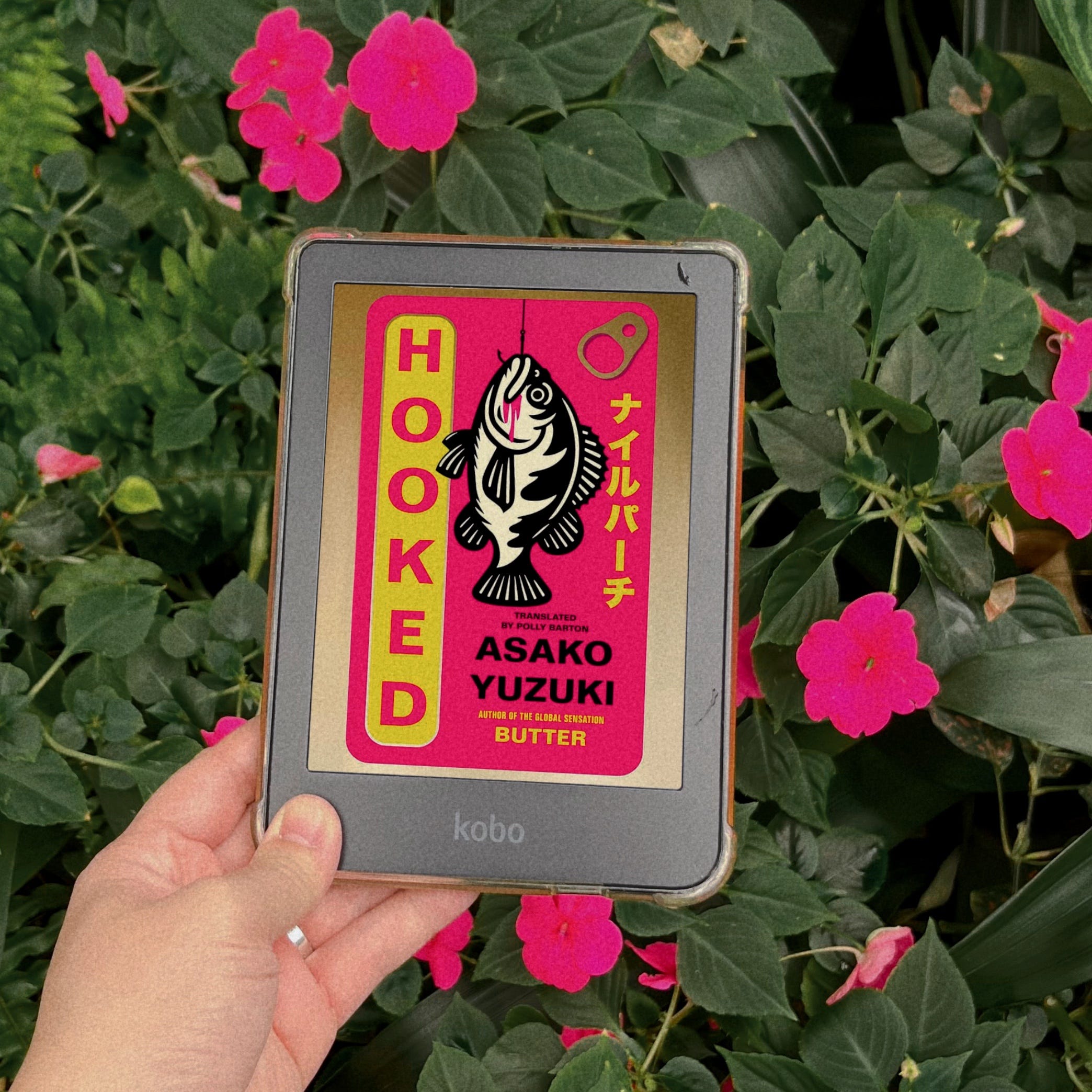
Extremely intriguing premise, I was hooked (haha) from the very start and it left me ruminating on the two main characters and my mixed feelings towards them. Most people believe perceive themselves as sensible and rational, unlikely to ever go so far as to quit their job and become a stalker-blackmailer, so-called normal, but this book raises the possibility of ‘normal’ people snapping at a certain point and becoming unhinged. I found myself alternating between disgust (’omg ew I would NEVER do something like that’), recognition (we all know/knew people who were actually like that), and sympathy (being alienated can warp anybody’s psyche).
Eriko has a good job in a manufacturing firm that she got through connections. In appearance, she is immaculate, but her major flaw is that other women are put off by her, so she has always longed for female friendships in vain. She becomes obsessed with a popular housewife blogger, Shoko, who she realises lives in her neighbourhood, so she tracks her down, memorises her routines, even figures out where she lives, and befriends her. At their first meeting, which she engineers, they hit it off so well that she’s convinced Shoko is The One, that woman friend who will make her life complete. When Shoko goes offline for a few days, Eriko grows increasingly distressed and decides to show up at her front door. It all goes downhill from there.
Major spoilers below!!
Shoko responds as anyone might when they realise the new person they befriended is likely to be dangerous because, I mean, Eriko literally found out where she lived and went there to look for her after just four days of absence. NGL that’s a huge red flag. She tries to gaslight herself at first, projecting her own feelings of inadequacy re: her inability to make friends with other women onto Eriko and finding reasons to give her another chance, but she also starts strategising how to nip this relationship in the bud, starting with slowly ghosting her.
Eriko feels Shoko pulling away because she’s not oblivious, just delusional, so she panics and that makes her bombard Eriko more, believing that if she could just explain herself one more time, reassure Shoko one more time, all the misunderstandings would go away and Shoko would become her best friend. This leads to a confrontation where Shoko tells Erika to back off, Erika tells Shoko she’s pathetic, and they separate but Erika continues to stalk Shoko online. She catches Shoko going on a date with another man, takes a photo, and blackmails her into becoming her best friend and doing best friend things like going overseas and having dinner together. She also coerces Shoko into giving her control over her blog and starts ghostwriting for Shoko. A friendship built on blackmail was not meant to last so last it did not. Erika becomes a shut-in and Shoko goes back home to the countryside to become her convalescing father’s sole caregiver, a role that taxes her so much she starts to harass another housewife blogger whose courtesy she mistakes for actual friendship, mirroring Erika’s obsession with her and ironically helping her empathise with Erika’s past desperation.
Some thoughts I had while reading:
What’s with all the fish?
The Japanese title doesn’t mean ‘Hooked’ but actually says ‘Nile Perch’, which is a little strange for a title until you get to the end. I like the translated title better seeing as how it encapsulates the story. The Nile Perch is a carnivorous fish that Erika is in charge of importing in Japan at the start of the novel. This fish is considered an invasive species because it eats up all the other fish species in any ecosystem it is put into. This was something that was discovered only after it was removed from its original location and released into Lake Victoria.
Eriko feels protective of the Nile Perch and the bad reputation it has, thinking that “it wasn’t the Nile Perch’s fault: it had merely been frantically defending its own territory. The tragedy had take place because the fish had been introduced into a lake that wasn’t its natural habitat”, also arguing that if humans hadn’t released the Nile Perch into a foreign lake, they “would have gone their whole lives without realising how ferocious they were”. I wondered if she related to this fish because she herself felt misunderstood and wrongly villainised when it could have been the environment around her that made her react to others in her offputting way. She compares both herself and Shoko to the Nile Perch after their friendship goes south:
“It was as if Eriko herself was the Nile Perch – or maybe that was Shoko? In any case, one of them had been tossed into a lake, and two creatures that were never even destined to meet ended up being thoroughly bewildered by the other.”
Both Shoko and Erika are women who don’t have women friends and who initially bonded with each other over this fact, until their respective true colours show. They also both crave, deep down, to have a fellow woman to rely on and open their hearts to. This makes Shoko compare them to the Nile Perch, a fish whose native environment does not have other fish, suggesting also that Shoko and Erika are from a different species, one not suited for communal living. Eriko suggests that when women start attacking each other even though they could have been peacefully coexisting, it is the result of too much contact:
“When the environment became saturated, then even those who had previously got along fine would set off down the road of attacking and killing each other. If Eriko began meeting Naomi Akagi privately, relations between them would falter. Naomi would start pushing Eriko away, and Eriko would chase her down to stop that from happening.”
It seems that keeping people at a professional distance is the only way she can spend time pleasantly with other women without wishing for more, and failing to get so, souring their relationship with her uncontrollable feelings. If she doesn’t seek emotional fulfilment from other women, she won’t act in a way that scares them off. This epiphany leads to her decision to camp in her ‘natural’ environment, the office, instead of transplanting herself into a new environment where she would “need to get hurt or get lost”.
Nobody is immune to obsession
Both Eriko and Shoko believed themselves largely ‘normal’ but they do know that they’re different from other women. This does not stop either of them from transgressing social boundaries or cultivating delusions about other people/ what kind of people they truly are/ the closeness of their relationship. The reader can tell that Eriko at the start is becoming overly fixated on Shoko, her thoughts definitely bordering on unhealthy obsession, but Eriko was unaware and saw herself as merely seeking friendship in a normal way, unlike those antisocial jobless loser stalkers:
“Eriko wasn’t a stalker: of that she felt certain. Stalkers were more isolated, people not recognised by society. They lacked imagination and consideration for others“
After she started blackmailing Shoko, she still believed that she was doing something acceptable and that the time they spent together was contributing to her becoming a ‘normal’ person who did normal friendship things like chatting and travelling together. She harboured an entire fantasy about how their friendship would benefit Shoko by advancing her career and she, the trusty sidekick, would forever be needed:
“Today, Eriko had succeeded in revealing herself to another woman for the first time since Keiko. She and Shoko had discussed their upbringings, talked enthusiastically about their favourite TV programmes and got in the baths together naked . . . Thanks to Eriko’s help, Shoko’s blog would be successful, and she’d release a book. Eriko would return to work, but rather than reverting to her former ways, she’d use her time after work and at the weekends to support Shoko. To do things for others and have them do things for her – this was her dream . . . This was the ultimate happy ending, uniquely possible to Eriko and Shoko. Such a narrative should in theory have been good news for Shoko. So why, then, did Shoko refuse to act as Eriko had hoped she would?”
The selfishness in her fantasy is transparent to all but herself. She wants to become helpful to Shoko not because she genuinely wants Shoko to be successful in the blogosphere but because she wants to receive credit for it, for Shoko to be so grateful to her that she would forever remain by Eriko’s side, thanking Eriko and stroking her ego. She saw Shoko ultimately as a side character through which she can develop her own main character. Eriko also projected fantasy onto Shoko when she mistook her “elusive prose” for a rich interiority “studded with precious nuggets truly worth listening to”, when in reality, there was nothing deeper there. She put Shoko on an impossible pedestal so that she could have something to get giddy over the way young teenagers swoon over their very ordinary-looking crush. When Shoko floats the idea of quitting her blog, it offends Eriko because she was parasocially involved in its running and she saw it as the vehicle of fate that rightfully united them:
“As concerned her best friend, though, it was the blog that had brought the two of them together – it was their history, their daughter. She couldn’t forgive Shoko for trying to put it to bed so peremptorily.”
By referring to it as “their history, their daughter”, it shows how Eriko believed the blog to be the result of co-creation, implying they had equal stakes and were equal partners. She’s not, though. She’s just another consumer or fan. Ultimately it is Shoko’s work, not the readers’ no matter how devoted. However, she is semi-correct in that this blog is the only access she had to Shoko’s life and when it is gone, her ties to Shoko will be tenuous at best. Eriko fears its dissolution because it would delete the foundation of their already flimsy relationship.
Envying other women is a trap, don’t compare their outsides to your insides
Shoko and Eriko both start out envying the other based on first/ shallow impressions.
“[Eriko’s] life had been spent building layer upon perfect layer from that flawless foundation, like an exquisite mille-feuille . . . It was people like Eriko Shimura who should be writing blogs – people born into wealthy households, flawlessly stylist in their attire, who could write about their days working in Japan’s largest manufacturing company. A life like that would surely look good however you sliced it.”
“Eriko had seemed tired, but she’d also had that sparkle unique to people living a fulfilled life . . . Eriko was way, way more distinguished than she was”
Shoko wasn’t too far off in deducing that on paper, Eriko should have had an ideal upbringing that turned her into an ideal person with an ideal lifestyle, but she did not manage to go one step further and see that all that effort is also a form of artifice. Mille-feuille is a fancy piece of confectionary that takes a lot of time and care to construct. Eriko’s impressive appearance was painstakingly constructed to maximise admiration from strangers. She does not run a popular blog for a very simple reason that Shoko was blinded to, being distracted by Eriko’s pedigree: Eriko is just not interesting enough. There is also is a little ironic foreshadowing as Eriko does do a hostile takeover of Shoko’s blog to cosplay the ‘lazy housewife’ life that she prefers reading about, and the result was the blog losing popularity because Eriko simply lacked any natural appeal. Whatever “sparkle” resulting from fulfilment was entirely imagined and projected onto Eriko by Shoko, who was delusional as well.
Women are unfairly expected to shoulder the caregiving and domestic labour, whether they want to or not
Although I wouldn’t say that this novel is overtly feminist (the women characters are definitely not girls’ girls, quite the opposite), it’s very easy to read it through a feminist lens because it implies that misogyny is baked into the very bedrock of society.
I don’t know about you but I was so annoyed at Shoko’s family members. Three grown men and neither of them can do a little cooking or cleaning? If her dad was useless, fine, he’s from the previous generation, that checks out, but her brothers cannot care for their own father or the house and need their sister to travel all the way back from Tokyo? Telling Shoko “it’s times like these that the women need to step in and show a man some kindness”? They’re weaponised incompetence-maxxing.
It sounds terrible to admit but when Shoko found her father’s unconscious body and believed him dead, I sympathised with her relief. She thought she was free at last with him properly gone as no one would expect her to keep returning to clean the house anymore. When she recalled the times her father acted like a petulant brat while her mother waited on him hand and foot, or the more recent times when she tried to get him to take care of himself and he brushed her off, it crossed my mind that this man was a burden. If he wanted to kill himself slowly through neglect then why not let him? Why waste time and energy to keep him alive or improve his health when he won’t lift a finger to help himself?
“This was what everyone had wanted, she thought – everyone around him and her father himself. He had died without causing anyone any bother, here at home.”
Fortunately, or unfortunately, he did not die but he did end up hospitalised and Shoko became his full-time caregiver, spending all her days at the hospital while dealing with the fallout of her marriage. Not that her father is even a little bit appreciative.
“[T]his was a man who took it for granted that women would serve him and act in his interests. His inheritance made him intolerably arrogant. Even after regaining consciousness, he hadn’t once thanked Shoko and seemed to show no awareness of the fact that she was currently away from her home in Tokyo.”
In a nice and heartwarming movie, this would be the part when Shoko and her father open up to each other, tearfully confront each other for past hurts, and then reconcile before he dies for real. This novel denies us a typical saccharine ending by giving us something more realistic and unresolved. Shoko’s father does not magically become good overnight or apologise for his shittiness, but Shoko does not need him to as she can make peace with her situation.
Another almost-father figure is Eriko’s colleague, Sugishita, who is known for secretly dating temps (women who do not have the educational qualifications to be hired full-time and so live in financial precariousness until they can find a man to marry to provide for them) and who has a pregnant girlfriend. Sugishita starts out dating a temp, Maori. Eriko envies Maori for her popularity but also looks down on her for being low-class. Everyone knows they’re dating, but Sugishita still hits on Eriko repeatedly trying to get lucky. One of his methods is to complain about Maori:
“From the outside she looks like any other young girl, right? But when you actually start dating her, she’s kind of full-on... She wants to cook for me all the time. It’s like she’s my wife or something. It weirds me out.”
He acts as if he didn’t like how maternal or wifely Maori was behaving, but when he knocks her up and they announce their engagement, that’s when Maori shows her true colours, giving him a different cause for complaint—she didn’t cook for him anymore. Once she baby-locked him, she stopped performing, and Sugishita quite literally throws himself at Eriko for comfort:
“Her mother pestered us into signing the marriage papers, but that was a mistake . . . This week she’s not made me a single meal. She’s left me on my own while she trots out every night to see her girlfriends and discuss bridesmaid shit”
Even someone who cannot read the room, like Eriko, can tell that Sugishita is a moron for taking for granted that he would be “babied by the women in [his] life”, like it’s his right to be served by his mother, then his wife.
On a related note, the phenomenon of ‘Housewife Blogging’ is rooted in toxic gender expectations
Shoko gains a large following and becomes popular online because she subverts expectations but she still ends up reinforcing them by presenting herself as a negative model.
The other housewife bloggers are “glamorous and well put-together” and they “all described their meticulously crafted lifestyles, filled with bright smiles, innovative ideas and delicious meals, 365 days a year . . . as if the business of daily life was unspeakably enjoyable for them”. Admittedly, I used to watch housewife vlogs because there was something mesmerising about seeing a woman deep-fry croquettes at 6AM in the morning, and I found myself soothed by their beautiful living spaces that resembled showrooms, but I also could not help but count the number of cuts and camera angle changes and announce it to my partner. I mean, it’s beautiful but it’s all fake. No one actually wears white linen with puff sleeves to deep-fry food. But I will say that housewife content creators generally work very hard to turn domesticity into something aesthetically pleasing. They are also selling fantasies.
Meanwhile, Shoko documents her “days spent lazing around on [her] arse”, which is equally if not more performative. Her blog’s name self-deprecatingly refers herself as “The Worst Wife in the World” because she barely does any housework or makes meals for her husband (nicknamed ‘The Demon King’ even though he does not impose on her indolent lifestyle in any way and financially supports her without complaint). All this is meant to contrast the idea of a good wife, she who devotes her entire existence and all the hours of her day in service to her husband and children. It’s tongue-in-cheek but her self-criticism is also sincere. She’s not being a feminist or trying to dismantle existing structures, if not she’d sarcastically call herself “The Best Wife in the World” instead. Her entire schtick is that she’s deliberately failing at her job, unlike all those other housewives who are doing their jobs fabulously.
Shoko knows that nobody would find her truly inspirational, the same way people envy pampered fat cats but would not actually try to achieve a similar life. For this reason, Shoko lies about getting hate messages because it gives her a reason to elicit sympathy from others. You’d think that most people would not want to get hate messages, but in a warped way, it’s true that getting hate is also proof of popularity and relevance. Shoko not getting anything but mild, supportive comments is seen as “proof that nobody envied her and her life . . . they didn’t go around thinking that they wanted to be like her” and that her audience only consumed her content for entertainment or to feel better about their own lives, which are more “polished” in comparison.
Not all female friendships, but some for sure
“Look at you! You hate women, you can’t get by without looking down on them, and yet you’ve been carrying around these overly high expectations of female friendship this whole time! I bet you picture it as some kind of female paradise, some glorious flower garden! And then when there is even the tiniest hint of difficulty between friends, you point your finger and laugh. Say, look, a woman’s enemy is other women, that proves men are better.”
Maori’s attack on Sugishita is sure to evoke conflicting responses but for me personally, I enjoyed seeing that man get properly beat up after all the sleazy misogynistic things he did. He accuses Maori of having unfulfilling female friendships, as evidenced by her vulgarity and violence, but as Maori points out, that’s hardly correlated. If a woman feels fulfilled by her friendships, that doesn’t mean that she will become a calm and demure woman who strives to please her husband. I mean, why would it? That’s so illogical and making it all about men, in fact, when Maori’s whole point is that her friends are her priority so she treats them as such, whereas he is not, so she doesn’t feel the need to treat him well. He’s jealous. For Sugishita to say that women are “cruel, and unbelievably shady”, that their bonds are “flimsy”, that they use other women and only befriend those they feel superior to, it just highlights his insecurity. He needs to believe that women are secretly all catty bitches who are fake supportive because he cannot envision a world where women do not need men to feel fulfilled.
Rather than being respected/ admired/ desired by men, I do agree that in recent times it is more significant to be popular with other women than with other men, or as Eriko says, there is a “perception that a woman was nothing if other women didn’t love her” and it’s because men can like a women for shallow reasons (e.g., she’s sexy) whereas to be widely loved by other women implies a certain virtuousness or goodness that overcomes the undercurrent of competition. I feel it too when I see a woman with lots of girlfriends who are happy to do a lot for her—I can believe that she is blessed because she deserves it somehow, she must be a wonderful friend to be so loved, and it’s not simply because she’s pretty or clever or rich. Whereas a woman who is shunned, even if I don’t have any negative experiences with her myself, I would see it as a red flag. This kind of thinking has become really common in the past decade, more so than when I was still schooling. No one used to talk much about so-and-so not being a girls’ girl or being a pick-me but now it’s in the common lexicon and a valid concern.
On the whole I don’t think this novel is presenting a charitable view of female friendships and how women relate to one another. I remember describing it to some friends when I started reading and they chuckled while remarking at the bleak worldview. Of course not all women are doomed to compete for male attention or validation till they die, and of course not all women behave as if it were a dog-eat-dog world and they must crush other women beneath their heels to advance in this world. Lots of women have no problems making and keeping women friends throughout their lives, from girlhood till adulthood. Such women are acknowledged in some ways in this book, e.g., through Maori who prioritises her girlfriends over anything else, or the group of girlfriends on the same flight as Eriko. But it would be a lie to say that women are naturally able to socialise well simply by being born female. Women don’t all naturally get along and a lot of it is the result of socialisation. There are some women who, like Eriko, can get along with men but not other women, while other women get their neurodivergence clocked at one glance and they get shunned by their peers throughout childhood. It’s not even a rare case, I think everyone must have seen or been that girl back in school, every class/ school/ cohort had at least one. It could be that they are ‘pick me’s going through their ‘I’m not like the other girls’ phase (quirk chungus…), or it could be that they genuinely cannot figure out the social codes for behaving normally so they end up creeping others out.
As for the women who want this creepy but harmless hanger-on to leave them alone, there’s no acceptable social script for telling another woman that you don’t want to be friends with her, not without coming off as rude or extremely cold-hearted. Shoko likewise cannot find it in herself to properly push Eriko away, leaving her with no choice but to do it slyly, starting with ghosting and avoiding her. When she loses her patience and tells Eriko to back off, Eriko notes that it feels like a breakup because it’s using the same format as one. There’s no established language for breaking up with a female friend.
“The thing about same-sex friendships was that, unlike with relationships between men and women, it was extremely difficult to bring them to a definitive end.”
One thing that this novel emphasises is how much of relationships between women, whether they’re supposed to be strangers or colleagues or allies, is built on an expectation of competition. When Shoko tells her potential editor, Satoko, about getting stalked by Eriko, Satoko immediately says it’s “women’s jealousy and envy”, which she sees all the time since she started working with homemaker bloggers. Is it, though? Is it really as simple and straightforward as Eriko envying Shoko’s life as a housewife? Shoko doubts it too and tries to provide more context, telling Satoko that Eriko has nothing to envy her for because Eriko “has got it all. She’s gorgeous, she’s rich, she went to a prestigious university, she works in a top-tier company, and was raised in Tokyo by her parents”, going down the mental checklist of what Shoko finds impressive about Eriko’s life. Without missing a beat, Satoko says it must be because Eriko is single. To Satoko, a woman can “have it all” but unless she is married, she definitely still feels inferior to the lowliest housewife for being unwanted goods. Her internalised misogyny then prompts her to inform Shoko that, by the way, she’s not a pathetically single career woman like Eriko, she is in fact “actually married with two daughters”, making her a real ‘has it all’ woman.
Something Eriko does that places an emotional burden on Shoko, and in the past, on Keiko, is her constant need for approval from the girl she’s fixating on and how she makes her need their problem. This may come from low self-esteem but it is also a form of self-absorbedness. When she does things for another, the end goal is to make herself feel good and important, to prove to herself that she is doing the correct thing as “she always wants to be the best”. They find her “draining” precisely her ego comes first, not consideration for the feelings of the people she is supposedly serving. As Eriko believes herself to be playing the role of “the perfect female friend”, she gets angry when she does not get the expected response of reciprocation, acceptance, and gratitude. She treats other women like slot machines—insert correct actions, receive validation—so it is no wonder that she is friendless at the age of thirty.
The conditions of Eriko’s blackmail are laughable because she was obviously trying to force a connection where there was none, hoping that mandatory proximity would somehow lead to the germination of something real:
“the mould that was commonly understood as closeness – which consisted in conditions such as meeting three times a week, going on holiday together, texting five times a day”
Shoko may be an emotional cheater, but being at Eriko’s beck and call in this way is surely a disproportionate punishment. Eriko is also way too old to be thinking that if she made another person act like a best friend, they would eventually grow to love her back. This isn’t an arranged marriage with the potential for genuine attachment; she is literally blackmailing Shoko into spending time with her.
I found the scenes where Shoko and Keiko interacted memorable because they wouldn’t have known each other without Eriko. How many people can say they bonded with their stalker’s ex-victim? It’s an interesting dynamic for sure. They had a lot of talk about even though it was their first conversation, which brought up the very relatable point of how it feels good to bitch about a common enemy. It’s not kind or feminist or moral, but it’s honest:
“Shoko also knew instinctively that dredging up the hateful feelings festering away inside you served to bond you with the other person like nothing else. It was fair to say that the only time Shoko has felt truly connected to another person was when bitching about women with other women”
The process of maturing doesn’t stop even after becoming an adult
The ending—I liked it!
There are people who hate a touchy-feely ending where the characters learn from their mistakes and mature into better people, but personally I enjoy such endings. Not if the whole book is like that (hence I cannot with healing fiction) but rather than having the characters go through all that just to, I don’t know, die or continue being deluded, I much prefer the compassionate approach of letting them reach a personal epiphany that helps them move on and make peace with their past. And honestly, it doesn’t take much to give people the space to reflect and grow at their own pace, as Eriko realises when she buys fast food in the middle of the night. There’s no need for societal upheaval or undoing centuries of work. All anyone needs is a place that will be open to all, open to them. I also really like Keiko’s speech:
“I think it’s when two people separate that the things they’ve learned through their friendship can really blossom. It’s all very well to stand on the sidelines and laugh at women for gossiping, and complaining, and comforting each other in a shallow, superficial way. But who’s to say that the ruthless urge to get at the truth, regardless of whether it breaks the other person’s heart, is more virtuous than phrasing your words carefully, out of consideration for another person? I understand now what a talent it is to show care for other people. I’ve always ridiculed it, could never be bothered with it, and that’s why I’m where I am now, with nothing . . . You’ve got to live. However hurt and embarrassed you are. Even if you don’t have any friends.”
One of the reasons why Eriko’s personal growth was stunted was also because she was afraid to move out and be on her own, without parental support or the familiarity of her childhood neighbourhood. She never left her comfort zone, so for her, “time passed by with perfect flatness” and adulthood made no demands on her that necessitated true change, leading to her choices becoming more “conservative, and she had gradually lost her powers of imagination, become ever more frightened of the unknown.” She was so risk-averse that she caged herself in a life that did not fulfil her. The good thing is that she’s only thirty, she’s still young, and she has the rest of her life to evolve.
Her big change came about when her mother finally breaks down and tells Eriko how tired she is, making Eriko realise that she had “never tried to imagine how anyone else was feeling, not even her parents” who she has been taking for granted, her mother most of all. And if she cannot even understand her own mother or extend empathy to her, it’s no wonder that she cannot build proper relationships with other women who have no obligation to love or accept her. Eriko also reaches the significant conclusion that she did not need to become like other women and have girlfriends to live happily:
“So preoccupied had she been by other people’s expectations that she’d never really asked herself what she liked to do. Walks, eating out, travel – the things that Eriko longed for were all pursuits that she could ultimately manage even without friends.”
She was already doing what she needed to be content but her previous fixation on needing to have friends to become ‘perfect’ was hindering her from seeing that clearly. Once she sees the truth, that friendship is not a magic balm that can make her feel whole, she becomes free.
For Shoko, her ‘happy’ ending comes with her finally confronting her father about his weaponised incompetence, but in a gentle way, while cleaning his feet for him in the hospital. The man had layers and layers of dead skin encrusted on his soles, which seems a fitting metaphor for the way he wielded self-neglect as protective armour, something he used to force others to take care for him the things he had too much pride to ask directly for help for. This reticence and poor communication is also something Shoko shares, even though she loathes to think of herself as similar to him in any way. When she’s done restoring his feet and also sharing her honest opinions and feelings with him, she looks at his newly soft feet and thinks:
“The wrinkles tracing their surface looked to her like a smiling face, and Shoko smiled back at them. Maybe she’d be able to unearth something similarly unterrifying from that godawful house. If she only put in the time, maybe something unsullied would emerge.”
Post-epiphany Shoko is able to reconcile herself with the unchangeable fact of her elderly and frail father and to see him as a person too, no longer just a target of her resentment. She forgives him for what he did (or more of did not) do, acknowledging that he is not responsible for her unhappiness and vice versa, but she also refuses to sacrifice herself for him, coming up with a proper care plan and telling him to his face what she can and cannot do. This is a marked difference from when she kept quiet but sulked about and hoped for people to read her mind and understand her passive-aggression and change things, exactly as her father did. I found her realisation very relevant:
“Saying that you can’t be bothered is, in effect, saying that you care about yourself most of all.”
“There was nothing so arrogant as the belief that people would understand you if you said nothing. Maybe she was the only person who could explain to her father how much simply opting out of the act of communication hurt and confused the people around him. She was past the point where she could let herself off on the grounds that she was scared or embarrassed”
Saying how one truly feels is scary because it entails vulnerability, but without that there’s no way the people you say you care about can know what’s going on in your head. It is troublesome to get emotional and fight with others and struggle to find a resolution, but stubbornly withdrawing is worse, more selfish.
Bonus quotes:
“Now you’ve put on weight and stopped bothering about your appearance, you don’t even have any male fans. This is why I hate men. If someone doesn’t register on their attractiveness radar, they can’t muster the slightest empathy for them.”
“Do you realise that practically all the women who become permanent employees here come from families like yours? Everything is determined, from the moment you’re born. Every day, I have to live with the knowledge that hard work gets you nowhere. You make out you’re this gloriously independent adult, but you know better than anybody that when push comes to shove, someone will step in to help you. Stupid women like you make me sick, going around with their noses in the air when they’ve been spoiled and given everything they want throughout their lives, are still being supported by their parents at this grand old age, and yet, for some reason, believe that they’ve done everything themselves.”