

Copies available from Difference Engine and Wormhole. Great for a gift!
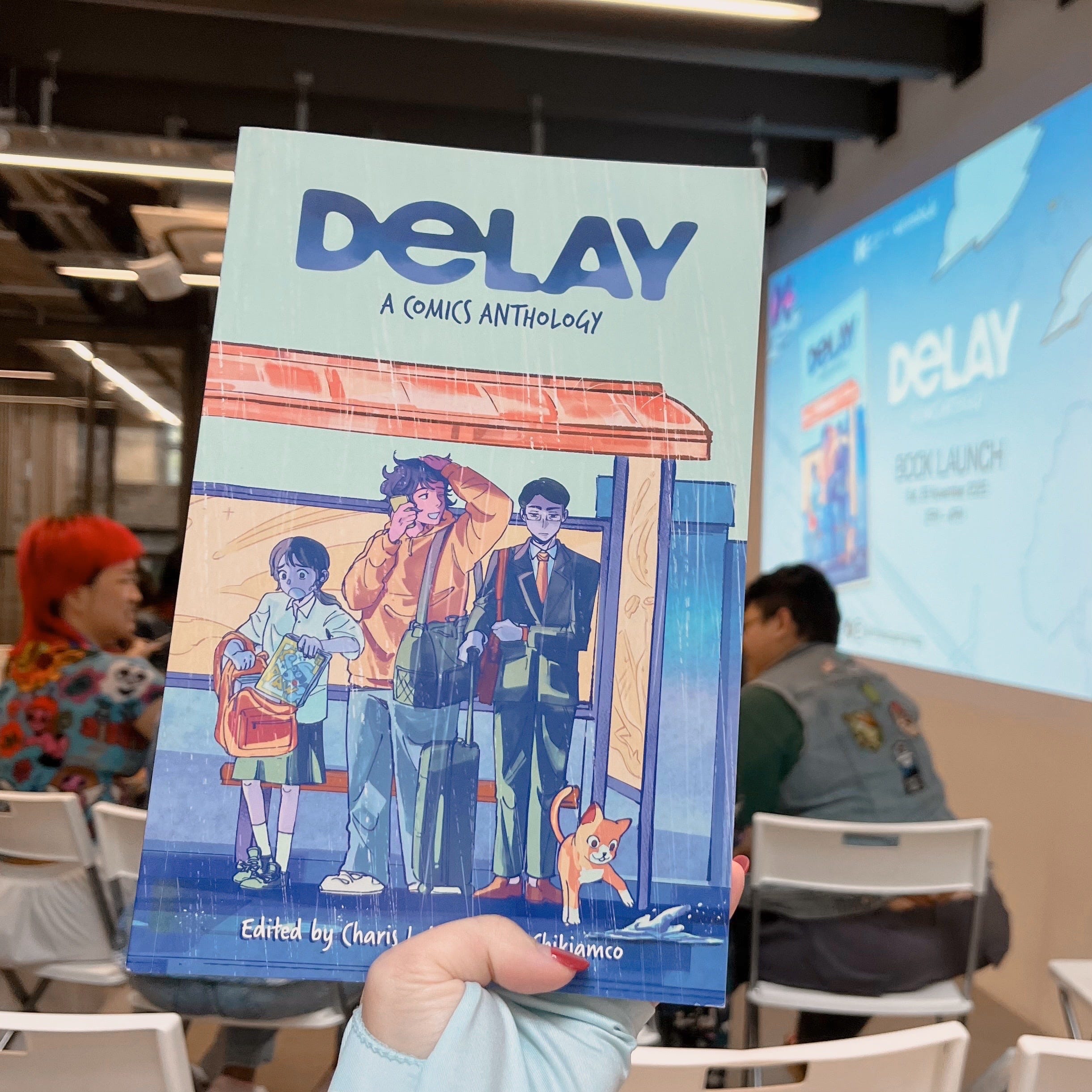
I recently read this anthology and attended the book launch. The thing about reviewing an anthology on a platform that prioritises brevity, like Instagram, is that it’s impossible to properly spotlight every story included. It did not feel right to say ‘okay here are my top three favourites and why’ when the stories are all very different to begin with in terms of both style and content. It also did not feel meaningful to talk about a comic without being able to make specific reference to a page, panel, or technique. I want to talk about what stood out to me in each one.
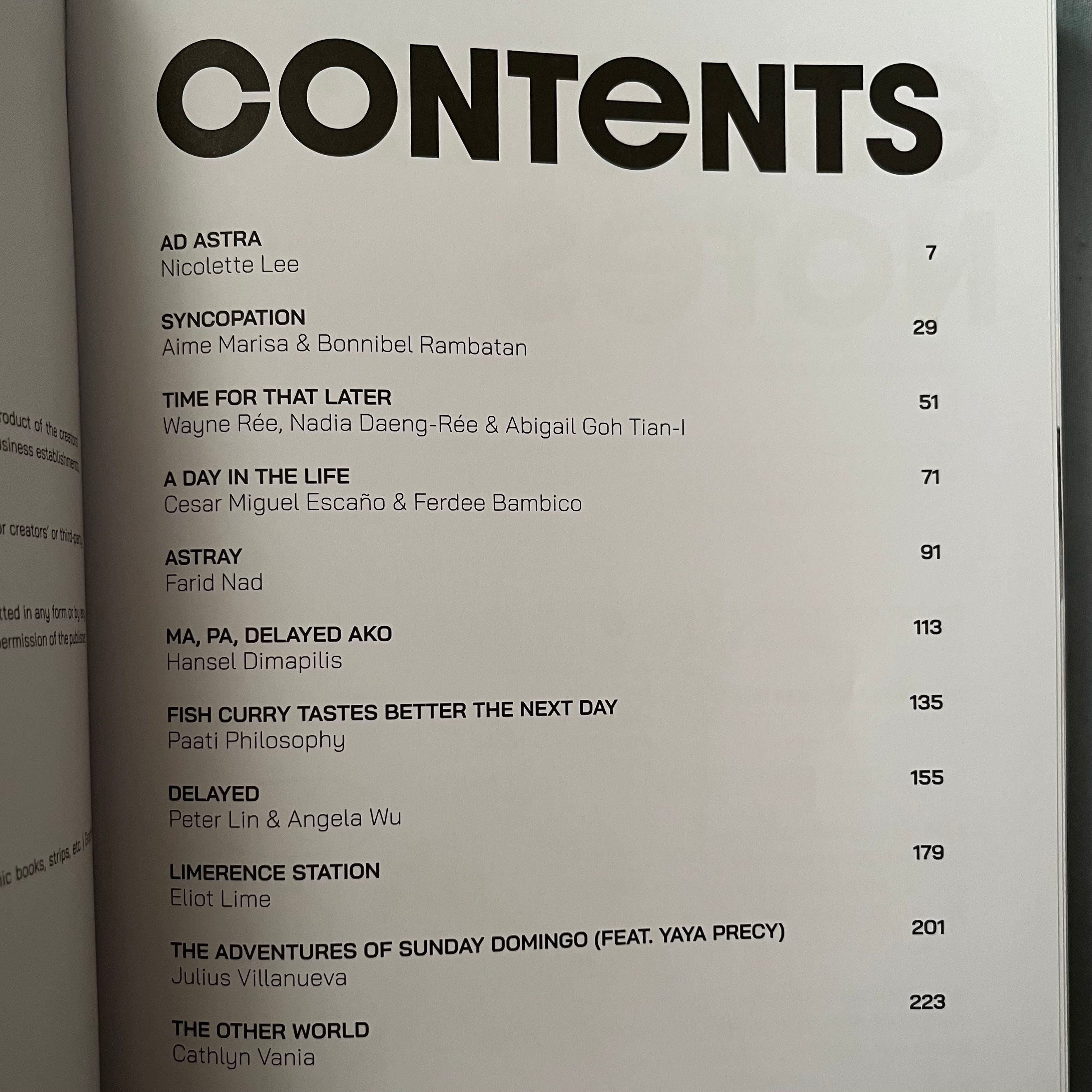
1. Ad Astra
The theme of delay here is shown through the spirit of Madam Yong refusing to move on from her past life into her next. A spirit guide repeatedly gently nudges her to accept the tea of forgetting so she can cross the bridge and start anew, but she’s too wreck by guilt over her ex-fiancé’s death to stop punishing herself by waiting and waiting for his delayed appearance. In a way, she may not actually believe that he’s on his way to her so much as she needs to believe that he is still around in some form so that she can atone and seek forgiveness.
I liked that the storyline is kept deliberately vague so it’s never made clear exactly how he died or how she died. You can read between the lines if you want, but the exact causes are not important because the main point is about her spirit being stuck in limbo. I came to my own conclusions when I reached the final panel and scrutinised the dates:
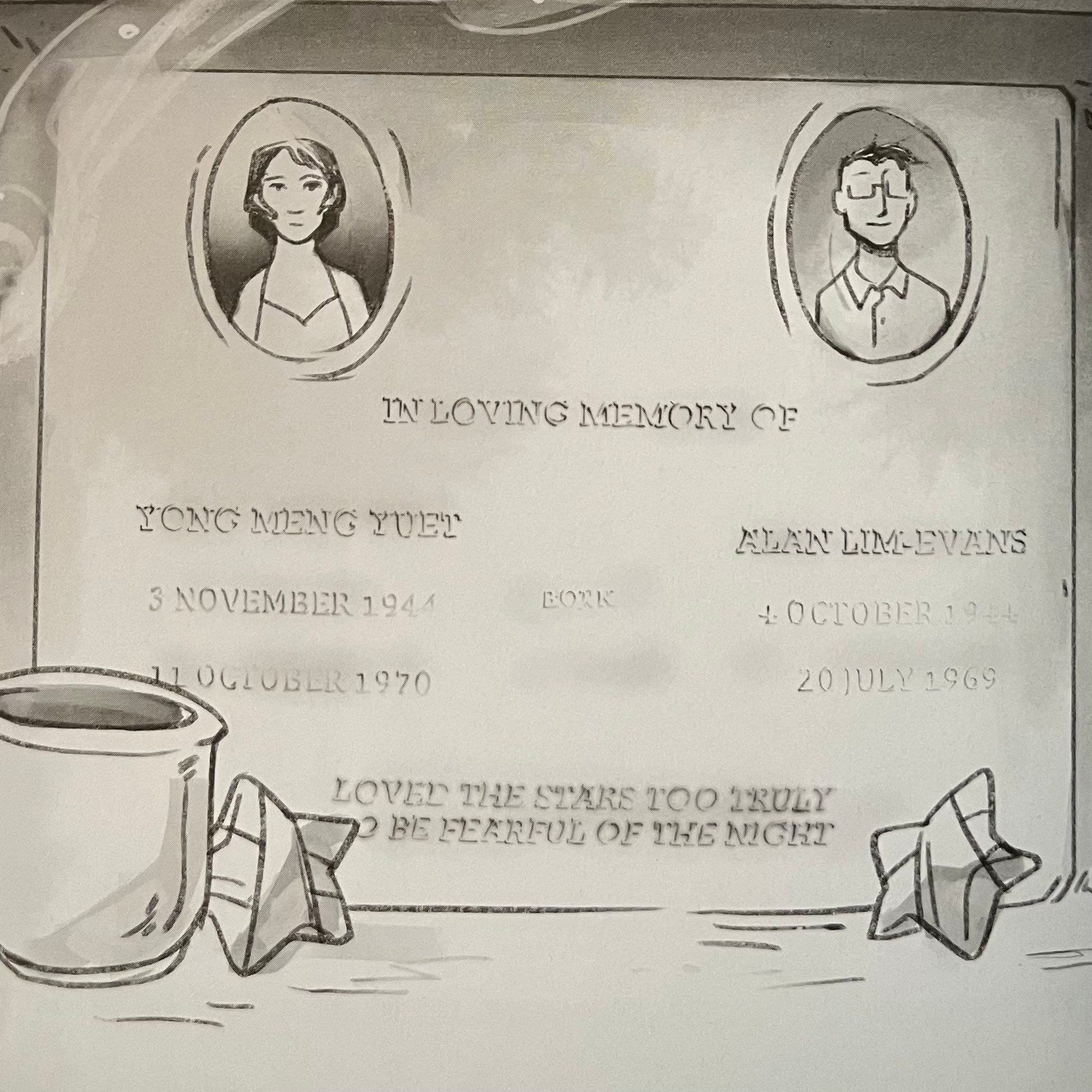
He was twenty-five and she was twenty-six, so I think he died by suicide (put vaguely by his sister as “his time to die”) and she followed the next year. I initially thought it could have been war or an accident but the dates don’t line up.
2. Syncopation
This is the first of two stories about the unfair ways a country’s government withholds citizenship from people within its borders, subjecting them to discrimination and exclusion from basic rights and opportunities. Two childhood friends grow up in tandem but only the main character was granted citizenship, which allows her artistic talent to receive proper recognition, while her much more talented friend was treated as a non-entity for something entirely out of her control (she was born before her mother was officially married to her father).
They used to play a game together but her friend has been MIA for a long time following a depressive episode. This comic uses game-like images to mimic the console’s interface (e.g. pixel art, error messages, player reviews) to show that the way things are done in real life is unreasonable, a broken system infested with bugs, hostile and inhospitable. Deserving people are barred from advancement for arbitrary reasons.


The meaning of the title is made clear towards the end when the main character manages to reconnect with her friend again. They’re living vastly different lives now, having had differing opportunities for advancement and achievement. Their rhythms no longer but match but the score of their friendship is richer and more complex for it.
3. Time for That Later
This is the first of two stories about dementia; this one focusses on the caregiver’s experience. At the launch, one of the authors said that everyone becomes a caregiver at some point in their life, be it for their children or for their own elderly parents, and also that everyone will need care eventually. The main character, Meena, puts her own life plans and goals on hold to be a primary caregiver for her father in his final moments.


Before becoming a caregiver, Meena is shown to be in balance with time passing at a normal, even pace: the panels are regular-sized , the background is clear, and her time is spent quite equally on various things (one panel for dad, two panels for fiancé, two panels for friends, two panels for exercise, and two panels for her job). However, after becoming a caregiver, the moments she has for herself are few and far between, represented through the narrower panels, while the rough, dark background and the dimmer tones of some panels suggest that even when she is taking a break, she cannot fully enjoy herself. The panels of her caregiving are stark in comparison. Meena also has significant weight gain and hair that she no longer gets regularly trimmed/styled by professionals, showing how her caregiving duties diminish her ability to practise self-care. The main idea is hinted in the title—she has time for all that later, but right now, no matter how hard it is, she has to focus on her father.
My favourite page is when they are playing a traditional board game together and Meena reflects on how this game allows them both to be their younger selves, honouring their inner children. For the duration of the game, they are just kids having fun together, not just father and daughter or burnt out caregiver and dementia patient.
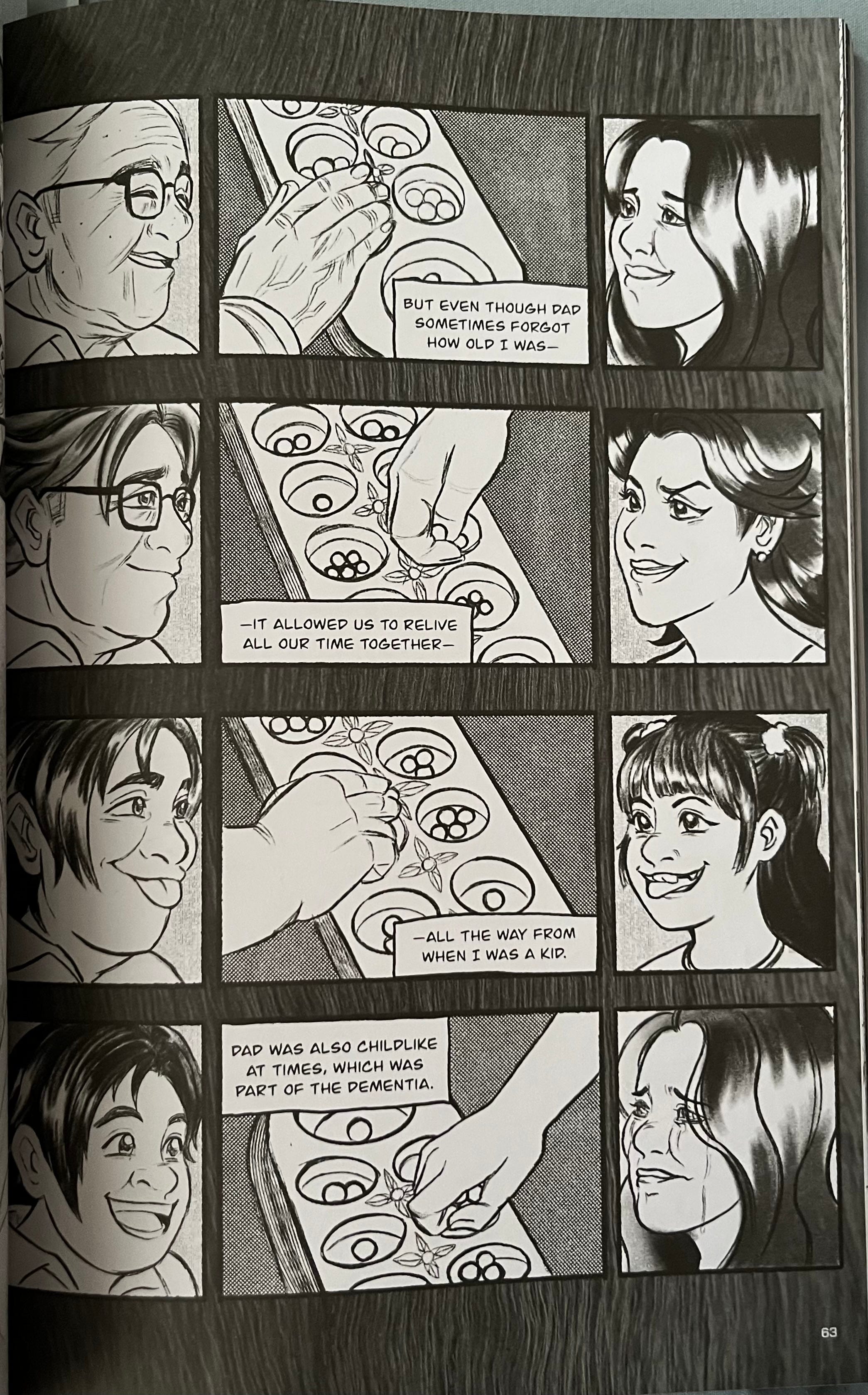
The left-side panels with her father show him ageing down and remaining a kid, reinforcing the effects of dementia, but the bottommost right-side panel shows Meena as she is in the present, an adult who is able to see her father in an oblivious childlike state, entirely dependent on her, and still love him as he is and for the versions of him that used to be.
4. A Day in the Life
This comic was a little more light-hearted, which I needed after sobbing my eyes out. It’s about a boy living in a futuristic Philippines with non-human neighbours, cybernetic people, hologram entities, and a landing port for spaceships. Being a kid, he just wants to find someone to play with him, so he approaches an alien whose ship just arrived and needs some time for repairs.


In just a couple of lines, we learn that the alien’s species does not explore or go to new places for fun. No action is done without necessity as its basis. The boy, being a child and thus focussed only on himself, does not read between the lines. He finds out only much later that this species’ lifespan is the duration of one earth day and his new friend has aged rapidly in the course of one afternoon. He apologises but she expresses gratitude instead for having made enough memories for a lifetime, quite literally.
How do we know when we have lived a life worth living? How do we know what is the best way to use our time? The tension here is between min-maximising life (e.g., spending every moment doing the ‘sensible’ thing, delaying gratification, playing it safe and risking nothing) and taking the road less travelled, doing something unconventional with no guarantee of reward. We could all stand to choose whimsy over the grind.
5. Astray
This comic is darkly humorous and the second of the immigrant stories. The main character was born in Malaysia but does not have citizenship, limiting their rights. They tried to be a good sport about it but it gets to a point, so they picked a place and time to commit suicide. And yet, even that does not go according to plan.


I liked how the interruptions to their negative thought processes were represented by intrusive speech bubbles literally covering out his thoughts, the first being the train announcement informing him that he will not be able to get to his final destination (aha), and the second being the stray cat that gives him a reason to continue living. I especially liked how these serendipitous events suggest the existence of a benevolent universe, one that will directly interfere in an individual’s life by sending flashing signs to say, “Don’t go yet, you’re needed here.” It must feel so validating after a lifetime of being rejected at every turn. The artist said they tried to draw the cat as ugly as possible but I don’t know, personal I found it super cute. Moral of the story: never kill yourself! Cute cats await you.
6. Ma, Pa, Delayed Ako
A university student living away from home lies to her parents about graduating on time when actually, she’s struggling to pass her classes and needs to delay her graduation. She doctors her grades and graduation photos to keep up the lie.


This burden on her conscience is represented by a black blob that sprouts on her shoulder, a weight she carries around 24/7. It grows larger and more autonomous the longer she hides the truth from her parents. Eventually, this insidious manifestation of her immense guilt starts taking up more and more space in the panels, blacking out the sky and her surroundings, colouring swathes of her life black and showing how all-encompassing her guilt is.
7. Fish Curry Tastes Better the Next Day
This comic uses food as a metaphor for the evolution of a mother-daughter relationship to say that it gets better over time, so you must give it time to ripen.


If you look at the written text on its own, it’s largely description of the fish curry cooking process and what happens to the various ingredients when you add them, cook them, then let them sit overnight. The written text itself does not mention the mother/daughter or draw direct comparisons. That’s the accompanying art’s job and such a good use of the comic medium.
I really loved how it subtly hinted at the necessity of conflict or friction to make the relationship stronger and better in the long run, e.g., the peppercorns add spice just as arguments do, and heat is needed to unlock hidden flavours. My favourite pages are in the second photo, where on the left page, mother and daughter are sitting in the same boat and heading in the same direction, but on the right page, their paths have diverged and they’re on separate boats doing separate things. It suggests that distance and time alone helps the both of them grow as individuals. By the time the daughter visits home, she is an adult with her own life and their relationship has matured into one that is comforting and nourishing, just like her mother’s curry.
8. Delayed
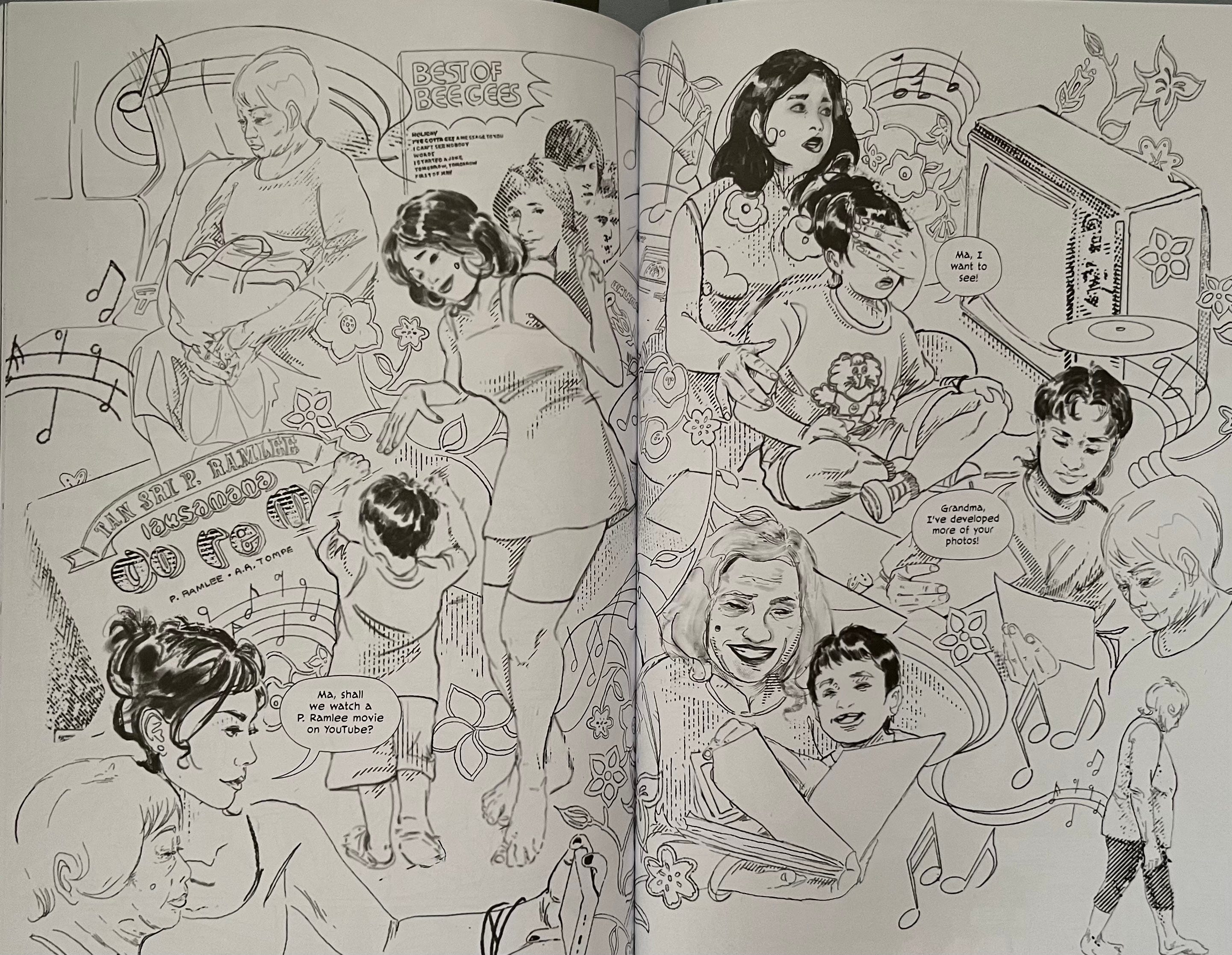
A grandmother suffering from dementia receives visitors. They talk about the past and try different methods to try to get her to remember who she was and who her own children/grandchildren are. Each page bursts with details; the past and the present crowd around collage-style and the ‘panels’ have porous borders, making the reader feel disoriented, overwhelmed, and confused. Where do I look? In what direction do I read the images? I found my eyes zig-zagging all over, trying to piece together what’s happening. The speech bubbles barely stand out in the cacophony; who is saying what and how are they related to the grandmother? Are they from the past or the present? Grandmother’s daughter (“handsome aunt”) looks so much like grandmother in her youth that it’s like looking into a mirror, adding another layer of confusion for the reader who is trying to process everything. It’s an effective way of making the reader approximate how the grandmother is feeling.


My favourite page is the one covered in cracks that extend to a memory of the grandmother’s younger face. It was such a visually stunning way of depicting the fragmentation of her mind and how her ability to recollect essential parts of her own life is failing. The image was also giving Junji Ito’s Tomie and I loved the creepiness.
In one of the pages, the grandmother listens to music that her grandson plays for her and it evokes a series of memories strung together visually on the pages by the musical staff lines. Time blends together and the narrative ceases to be anchored by chronology; the people themselves instead become dual focal points, their past selves (kept alive by memories) and their present selves co-existing on the same plane. The act of recollection, then, is to fold time in half and allow two points on the same line to touch briefly.
9. Limerence Station
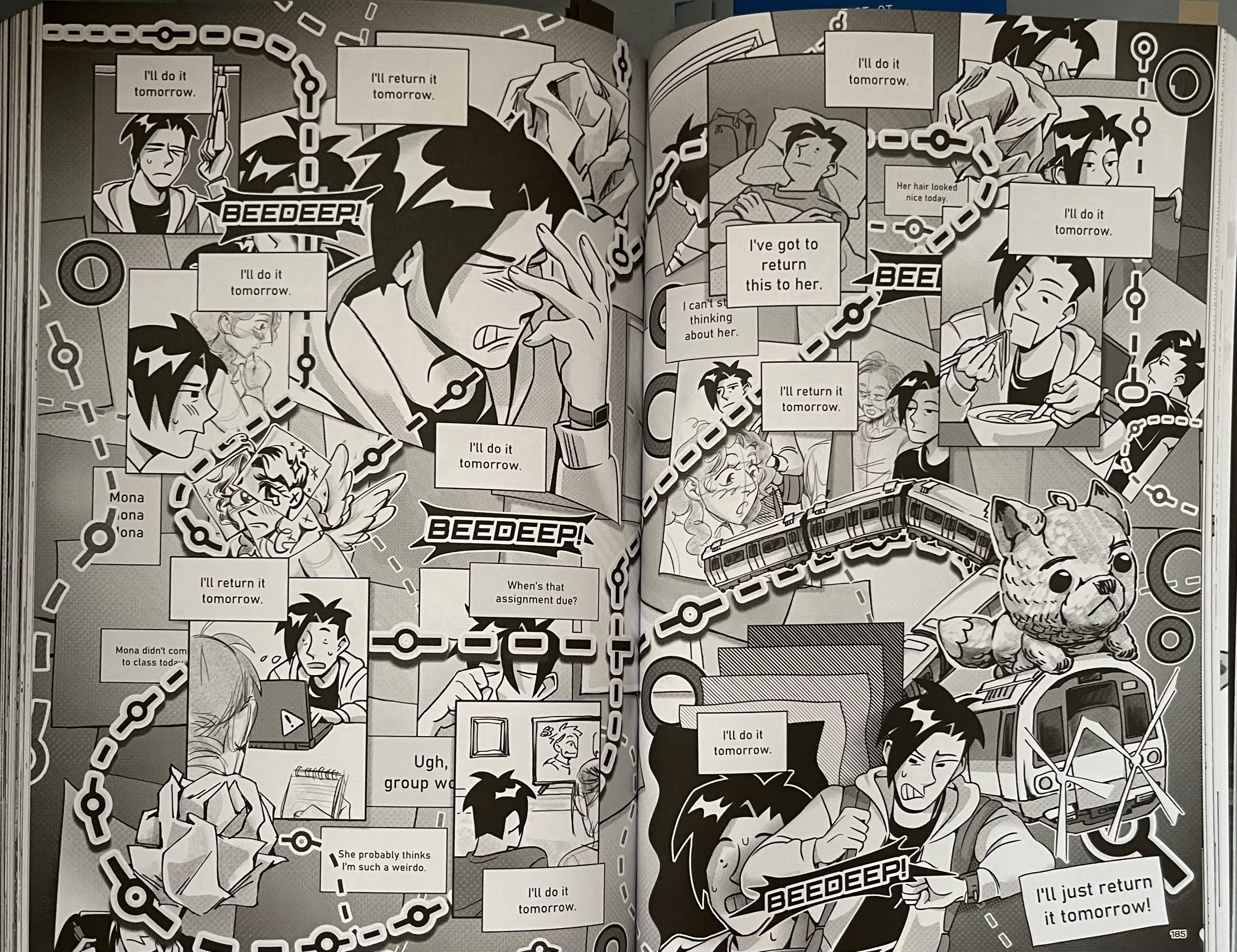
I found the style of this comic striking, probably because I’m a manga reader. In the spread below, I liked how the train moving forward from station to station is a metaphor for the steady but unrelenting march of time. Three mundane months of the main character’s life gets condensed into snapshots. The beep of his watch alerting him to the end of the period also alerts the reader to yet another missed opportunity for the main character to connect with his classmate, Mona.
The main character’s problem is that his social anxiety manifests in antisocial behaviours. While everyone around him seems to have no problem talking to each other, he is friendless and also unwilling to make the first move for fear of being rejected. His interest in the “pretty” Mona, though, is apparent from the start. Like the rest of his ‘faceless’ classmates, Mona’s face from his POV is a composite of attractive features resembling a shojo manga heroine with glossy hair and big sparkly eyes. In the second page below, after he lashes out at her for bumping into him, he anticipates a range of negative reactions from her as shown by the semi-concealed sketches of her face. She defies his expectations when she apologises to him and the way her character is drawn changes and resolves into something more solid, going from abstract to more realist (but still sketchy) as she breaks out of the ‘page,’ suggesting that he is seeing her as a person for the first time.


As they speak face to face and Mona opens up to him (third page), the residual sketchiness gradually disappears and she becomes more and more real to him, and therefore, someone he cares about enough to make amends with.
10. The Adventures of Sunday Domingo (Feat. Yaya Precy)
This comic made me feel the most uncomfortable, in a good way, because it refuses to give us a happy but unrealistic ending. The main characters are Sunday, an underaged comic artist of some acclaim, and Precy, the domestic helper that joined her family when she was a toddler. Precy is basically Sunday’s surrogate parent as her own parents prioritise other things (like career) so they outsource anything related to her day-to-day wellbeing to Precy. They are absent to the point of neglect and if Sunday makes a demand on their time, even in advance, it’s not taken seriously and is treated as an inconvenience/ nuisance. This is a familiar arrangement, even in Singapore. Makes you wonder why people even bother having a child if they don’t plan to spend any time with them. In the spread below, the comic Sunday is drawing on the left page is a direct reflection of the various times her parents let her down with their absence. On the right page, we see Precy remaining by her side and supporting her steadily through each instance.
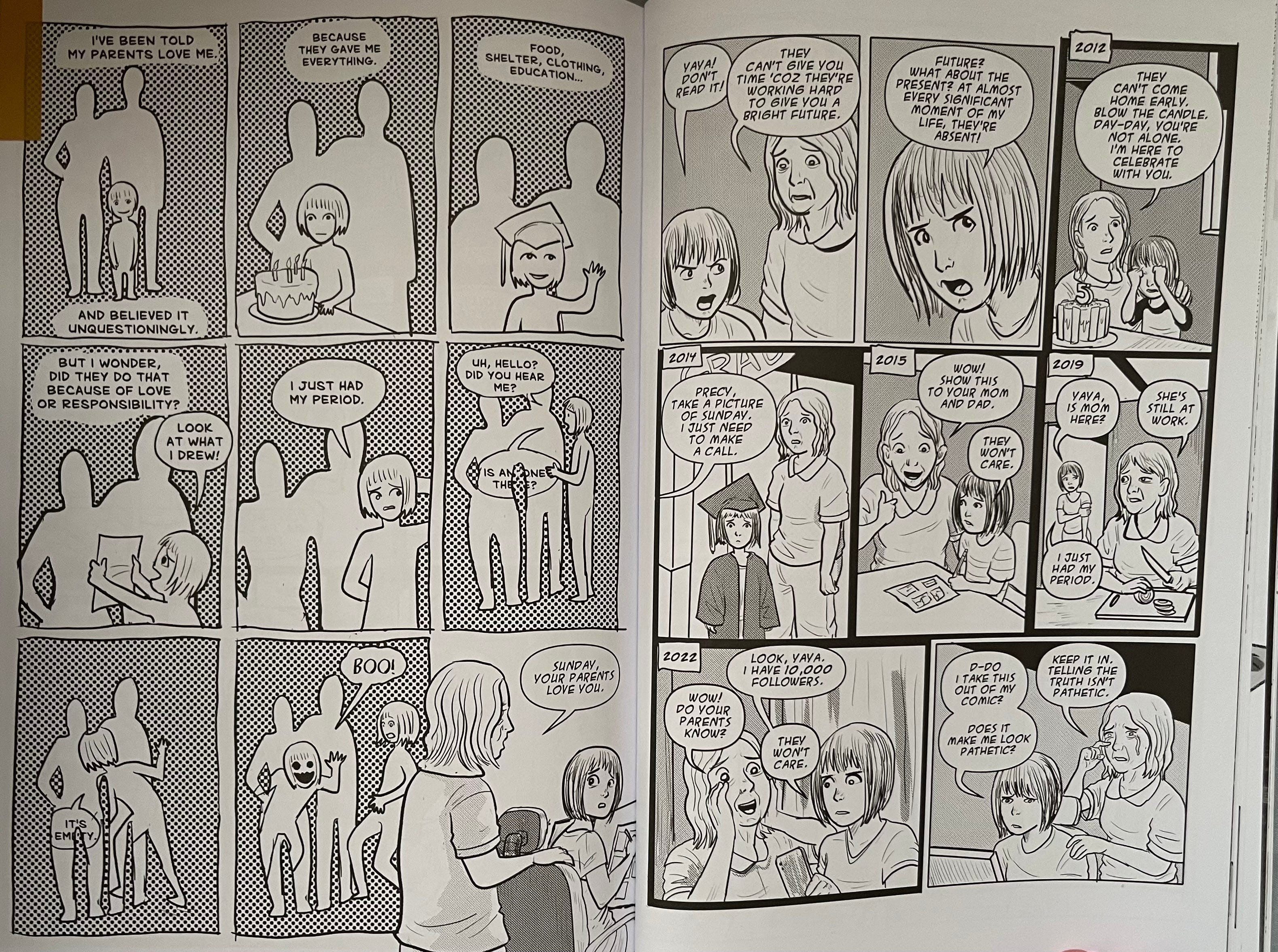
The result of this brand of upbringing is that Precy ends up being the only adult in the house who knows Sunday well, what she likes/dislikes, her hopes, fears, and dreams. I did find myself thinking that Sunday was a self-absorbed brat but she’s quite literally a teenager, of course she’s self-absorbed. It’s not like she can override her parents’ decisions or grant Precy financial freedom. Precy loves Sunday as her own daughter, choosing to sacrifice being present for the birth of her own grandchild so that Sunday can go for a convention she was invited to. I think that at the end of the day, the fact remains that they are employee and employer’s child, so no matter how much they would like things to be different, Sunday’s parents are ultimately in charge and the power dynamic between them will never be equal. That does not mean that the love between them is not real, though.
11. The Other World
The final comic in this anthology utilises the motif of a quilt or tapestry. The main character has a hard time staying in the present and not dissociating or getting lost in the other world in her head. Another her exists in that world, and as they both intrude into each other’s respective worlds, the worlds start seeping into one another. The boundary is muddled and she finds that her relationships are suffering for it. In the first page below, as she allows herself to be drawn in by her shadow-self, her head is separated from the rest of her body the way light refracts when passing through glass, representing her disembodiment from reality. The disjointed and disharmonious quilt (second page) made up of elements from both worlds and menacing images represents her dissatisfaction with this arrangement.


The only way forward is to rip it all apart (third page) and rebuild her life, this time with deliberation and intention. The new quilt exists only as orderly borders framing the page (fourth page) but they do not intrude on the present when she is spending time with loved ones. I liked that there was a blank space left for a future patch to be sewn in, suggesting that both worlds have room to grow.